PR vs Reputation Management. What Is the Difference?

If you ask a few business owners what the difference between public relations and reputation management is, most of them will say that they are basically the same thing. However, this is not true because there are a few differences. Understanding them is important if your brand is dealing with damaging Google results, negative media coverage, harmful online content, or fake reviews.
The professionals at NonDetected have a lot of experience in this field, so they clearly know the difference between PR and reputation management. They are ready to explain things to you, including where they differ and whether they can be combined. You will also find a few examples for a better understanding of the matter.
Table of Contents
- What Does Public Relations Mean?
- What Does Online Reputation Management Mean?
- 7 Major Differences Between PR and ORM
- Real-Life Scenario of Public Relations and Reputation Management
- Why Does This Difference Between Online PR and Reputation Management Matter?
- Are There Any Similarities?
- Example From Our Practice of Crisis Management
- Why Ask for Professional Assistance?
What Does Public Relations Mean?
To understand the difference between ORM and PR, you need to figure out what each of them means in the first place. Public Relations happens to be the strategic practice of managing how a brand interacts with the public. The purpose is to shape perception and build trust. Basically, PR is about positive media attention and is strictly about influence, not control. This implies that it focuses on press releases, media relations, thought leadership positioning, and crisis communication messaging.
PR tends to be proactive. And authenticity is a cornerstone of reputation PR in an age where consumers are incredibly skeptical of corporate messaging. For instance, when a startup introduces a new product, it might hire a PR agency to publish articles in industry magazines, arrange interviews with the CEO, and secure media coverage. The agency might also promote customer success stories or present the founder as an industry expert through guest contributions and speaking engagements.
Media relations builds credibility, visibility, and authority over time. It forms the narrative around a business and strengthens brand recognition. At the same time, it is necessary to realize that there are certain limits. PR does not directly erase damaging information from the internet. Instead, it is focused on adding positive signals and not deleting the negative ones.
What Does Online Reputation Management Mean?
Reputation management implies influencing, monitoring, and protecting a brand. The approach also implies deleting information that affects how people or businesses are perceived online. The main distinction between PR and RM is that the first one is focused on controlling risk, while the second one is more about creating visibility. Reputation management deals with the digital footprint that already exists.
The process comprises:
- Search engine reputation management;
- Online review management;
- Content suppression strategies;
- Platform-based deletion requests;
- Legal takedown coordination;
- Crisis containment;
- Continuous digital monitoring.
In many situations, the process involves analyzing if damaging content breaks platform policies or legal standards and taking legal action to solve the issue. A well-engaged reputation management strategy builds trust and loyalty, which is fundamental in competitive business environments.
ORM is often confused with PR, but they serve very different purposes and employ different strategies. The difference between public relations and online reputation management is that the latter tends to start when negative content is already visible. It can be anything from fake reviews and defamatory articles to harmful search engine result and impersonation accounts. It is often defensive and reactive in nature.
At the same time, reputation management can also be proactive via monitoring systems and preventive strategies crafted to identify risks early. The goal here is to minimize potential threats before they become a significant issue.
Effective ORM builds trust with customers, influences their purchasing decisions, and enhances brand loyalty.
7 Major Differences Between PR and ORM
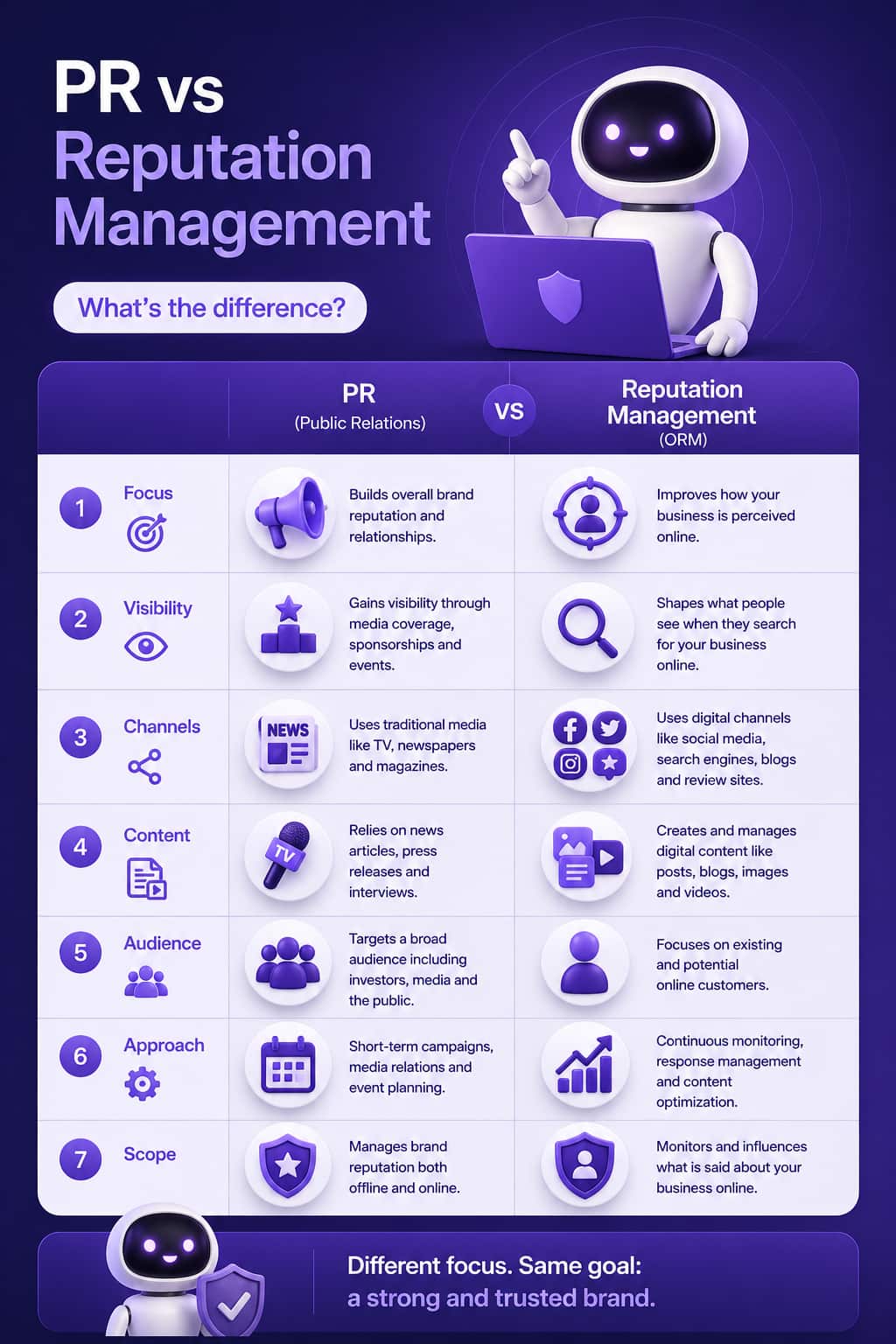
Even though public relations and reputation management both have an impact on the way a business is perceived, they solve different issues and operate in different environments. ORM is mainly technical and risk-focused, while PR is broader and visibility-focused. Our experts highlight the main distinctions, and you are welcome to get acquainted with them.
Focus Objective
As mentioned before, reputation management is about how a business is perceived by others. The return on investment of ORM strategies is determined by how the online visibility of a brand is improved in a positive light. PR is more about managing the overall reputation of a business. It comprises a set of approaches to improve the company`s standing with its different clients and stakeholders.
Brand Visibility
When it comes to building and managing a brand`s reputation, ORM takes a more digital approach. It aims to figure out what individuals see when they search for the business online and what sort of perception there is. PR, on the other hand, takes a more traditional approach, making sure that the company gets enough visibility via sponsorships, media coverage, and events.
Channel Distinctions
Another significant difference between PR vs ORM is how they approach the audience. Reputation management utilizes social media platforms, search engines, blogs, and review websites. Public relations is focused on traditional media, which includes TV, magazines, newspapers, etc.
Media Positioning
The reputation management channels are different, so the media positioning also differs. Reputation management deals with business visibility through digital content, such as social media updates, blog posts, images, videos, etc. When it comes to PR, there are more ordinary collaterals like news articles, releases, interviews, and others.
Target Audience
In the case of ORM, the major target audience is all existing and potential online customers. PRis focused on a broader audience, which includes investors, customers, media outlets, etc.
Tactical Approach
When it comes to online reputation, responding to online reviews, monitoring online content, and crafting positive content never stops. PR strategies are more about crisis management, media relations, social media marketing, and event planning.
Reputation Management
Online reputation management implies identifying, monitoring, and influencing what is said about a business online. At the same time, brand’s reputation management in public relations is about managing the overall reputation of the brand, both offline and online.
Real-Life Scenario of Public Relations and Reputation Management
So, what is the differnce between PR and ORM? If you still find it hard to understand that, the NonDetected professionals are here to share a real situation. It will help you understand how PR and reputation management would handle the same scenario.
A competitor posts defamatory content about a brand on a blog, and it appears on Google.
PR will do the following:
- Publish a response statement;
- Pitch positive media stories;
- Arrange interviews;
- Promote positive customer testimonials.
The point is that they will do their best to make people forget about the negative article by adding more positive content to the internet.
A reputation management agency, such as NonDetected, will focus on information removal. That is why our approach will include the following:
- Legal and policy analysis of the content.
- Identifying violations, such as defamation, copyright, impersonation, false claims, etc.
- Filing platform removal requests.
- Submitting legal notices if necessary.
- Coordinating de-indexing from search engines.
- Monitoring re-publication risks.
If it is possible to remove negative content, it should be done in the first place. There is no need to worry if this action fails because our experts know a lot of other approaches that will help your business recover.
Why Does This Difference Between Online PR and Reputation Management Matter?

The distinction between digital PR vs ORM is something you should understand because it is not just theoretical. The truth is that it directly affects business outcomes. If you opt for the wrong approach for the wrong issue, it can delay solutions and increase reputational risk.
If your goal is brand awareness, growth, and market positioning, then PR is critical. It will help you strengthen authority, gain media exposure, and shape how others perceive your business.
In other words, PR creates a compelling brand story while reputation management monitors public acceptance of that exact narrative.
In the case where the primary goal is crisis containment, damage repair, or risk elimination, reputation management is what you need. When damaging content is visible online, the exposure must be addressed.
If you fail to understand the difference between PR vs ORM, there can be serious consequences, such as:
- Wasted budget;
- Delayed crisis response;
- Ongoing digital exposure;
- Lost investor trust.
At the same time, if you realize how they differ, you are more likely to opt for the right tool for the right issue.
One of the best solutions, though, is to ask for assistance from a reputable agency, such as NonDetected. In this case, your problems will be addressed professionally.
Are There Any Similarities?
Public Relations and Online Reputation Management are related but distinct concepts that involve different goals, strategies, and tools. Even though there are a few distinctions, PR and ORM still have a few similarities. Both approaches are critical for establishing trust and loyalty among clients, investors, partners, employees, and the general public. They intend to enhance the image and credibility of a brand or a person.
While PR is focused on creating positive messages and stories, RM works on handling crises, managing online feedback, and using SEO and content creation to form online perception.
Both play an important role when it comes to shaping public opinion and maintaining a good personal or business reputation. Moreover, it is a great idea to use PR and ORM if you want to succeed.
Example From Our Practice of Crisis Management
A technology entrepreneur contacted NonDetected after finding out that an old legal dispute article ranked first on Google. A PR agency had already worked on numerous positive customer feedbacks and feature articles, but the negative content still ranked above them. Traffic analysis showed that investors followed that link in the first place.
Our experts, who know everything about OAO vs reputation management, chose the following strategy:
- Legal review revealed outdated and misleading information.
- We submitted removal requests based on inaccuracies.
- Our experts coordinated the de-indexing process.
- We monitored reappearance.
As a result, the content was deleted from search indexing. Only after that, the positive PR materials started working properly. The conclusion is obvious, which is that PR is powerful, but it fails to outrank severely poor content without a structural approach.
Why Ask for Professional Assistance?
Even if you understand the difference between online reputation management and public relations, this knowledge might not be enough to solve your issues. That is why it is always a great idea to ask for help from agencies, such as NonDetected.
Our experts assist brands and individuals in regaining control over their digital presence by focusing on structured information deletion and risk mitigation. While many agencies concentrate on publicity, our priority is eliminating harmful exposure at its source whenever possible.
Our outstanding specialists assist clients by:
- Identifying policy violations in defamatory or misleading content.
- Submitting platform-based removal requests.
- Coordinating legal takedown procedures when necessary.
- Removing fake or abusive reviews.
- Handling impersonation and identity misuse cases.
- Managing escalations with digital platforms.
- Monitoring search results to prevent recurring risks.
Our approach is analytical and compliance-driven. Every case begins with a detailed assessment to figure out if deletion is legally and technically possible. If it is, our professionals solve the issue step-by-step as quickly as possible.
When it is not possible to remove negative content, NonDetected collaborates with our partnered companies and opts for strategic alternatives, including suppression techniques and coordinated PR efforts. This way, your problem will still be solved.
There is no need to doubt. Just contact NonDetected, and we will help to regain a positive brand image and make your business succeed.


