How to Deindex a Page From Google If It Belongs to Someone Else?

You will most probably start wondering how to deindex a page from Google as soon as you see a source that exposes your private data, spreads false information, or damages your reputation. Things become complicated as soon as you realize that the page does not belong to you and you cannot control it. You cannot delete it, log in to the website, and click remove, but these details appear as soon as someone searches your name.
This article from NonDetected is exactly for this kind of situation. Here, our professionals intend to share some tips on how to deindex a page from Google if it belongs to someone else. You will find out what you can do on your own, step by step, when to escalate, and why professional assistance can often make the difference between failure and full removal.
Table of Contents
- Why Google Deindexing Problem Matters These Days?
- How Does Deindexing Differ From Deletion?
- What Sort of Content Can Be Deindexed from Google Search Results?
- Steps to Take to Deindex a Page That Does Not Belong to You
- What Should I Do If These Requests Are Not Successful?
- How Professionals Manage Deindexing
- How Deindexing Affects AI Search and LLMs?
- When You Should Seek Professional Assistance
- Act Quickly and Solve the De Index Issue Today
Why Google Deindexing Problem Matters These Days?
Online reputation means a lot these days because it is a part of your identity. The thing is that a single defamatory post, leaked photo, or exposed business complaint can be seen on the first page of Google and shape how others perceive you before you even get the chance to explain.
For individuals, this can mean lost job opportunities, broken relationships, and emotional stress. For businesses, it can mean decreased client trust, lower conversions, and financial loss. In today’s hyper-indexed world, what shows up in search engines is what people believe.
That is why learning how to remove indexed pages from Google is important. Deindexing implies erasing those links from search results and can be pursued through a formal request removal proces so that, even if they still exist somewhere on the internet, they no longer appear when someone searches your name or brand.
How Does Deindexing Differ From Deletion?
Before you learn how to remove an article from Google search results, you should understand the difference between deletion and deindexing. The thing is that both terms tend to be confused, but they have different implications.
Deletion refers to the complete removal of a piece of content from the internet, which can be a post, article, image, or comment. When something is deleted, it no longer exists on the web. This implies that no one can access or view it. However, this action can only be performed by the content owner, website administrator, or platform moderator. If the web page belongs to someone else, you typically will not have the authority to delete it directly.
Google deindexing, on the other hand, focuses on removing that same content from search engine results. The page itself remains online, but it becomes practically invisible to anyone who looks for it. In other words, people will not be able to find the link by typing your name, business, or any related keywords into a search engine.
When you cannot delete someone else’s page or post, deindexing becomes the next best option. It helps you protect your privacy, reputation, and digital presence, ensuring sensitive or defamatory information does not appear publicly in search results.
What Sort of Content Can Be Deindexed from Google Search Results?
Google regularly updates its content removal and deindexing policies. Currently, users can request Google to unindex site even if they do not control the web page if the information belongs to one of these categories:
- Personally identifiable information, which includes your phone number, home address, email, ID, or financial data.
- Copyright or trademark infringement. This happens when others repost your logo, content, or business materials without your permission.
- Private or intimate pictures. This category is about non-consensual intimate content or deepfakes.
- Targeted harassment or doxxing. This category includes content that discloses your private information with the intention to cause harm.
- Sensitive personal leaks. This category includes any financial, medical, or identity-related leaks that are shared without your permission.
- False statements or defamation. These are harmful false statements that can ruin your personal or professional reputation.
- Irrelevant or outdated personal information. This category includes expired arrest records, old court cases, or previous employment data.
It is also possible to remove from Google index outdated content, where the page`s images or text do not exist on the live website anymore, but are still visible and cached in search results. Bing, Yahoo, and DuckDuckGo have similar policies, but they tend to come with more limited forms and slower processing.
Steps to Take to Deindex a Page That Does Not Belong to You
If you want to solve the issue, you need to learn how to deindex website from Google search results. Further, you can find a step-by-step guide created by the NonDetected team.
Step 1: Identify the Violation and Gather Evidence
Before you send any request, you should determine why this page should be erased. The reason can be anything from sharing intimate content to copyright violation.
As soon as you answer this question, you should collect the exact URL or the page, screenshots of the content, the time and date of discovery, proof of ownership, etc. You should make sure that all this information is organized well because it will be required if you decide to escalate.
Step 2: Use Google’s Public Removal Tools
Google comes with a few removal tools that are accessible even without owning the site:
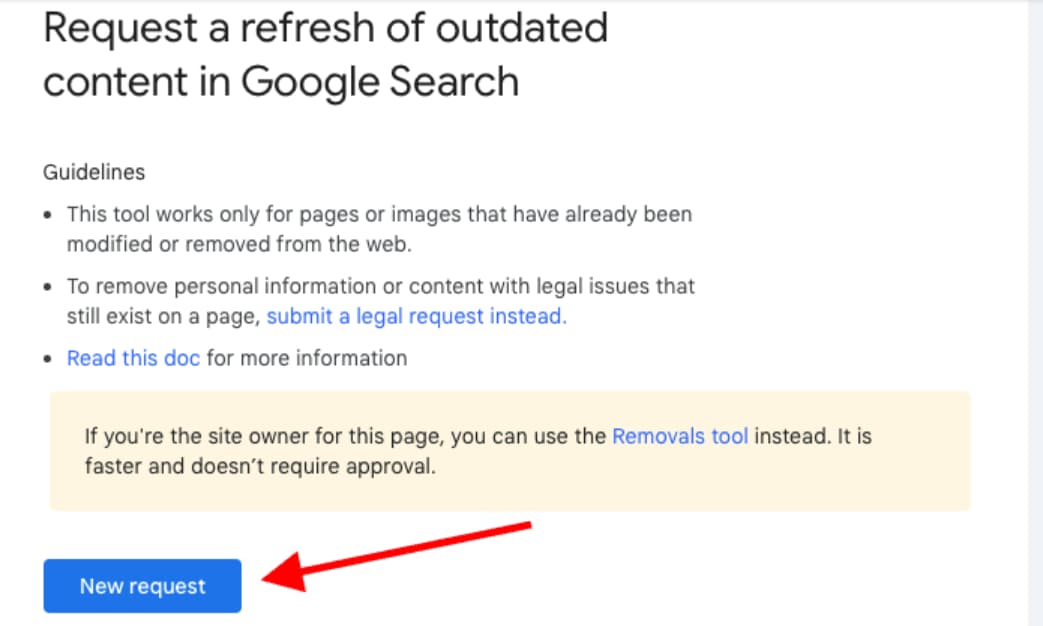
- The remove outdated content tool can be utilized when the page was edited or deleted, but Google still shows old cached data. All you need to do is provide the cached and live versions, highlight the part that is no longer on the page, and submit.
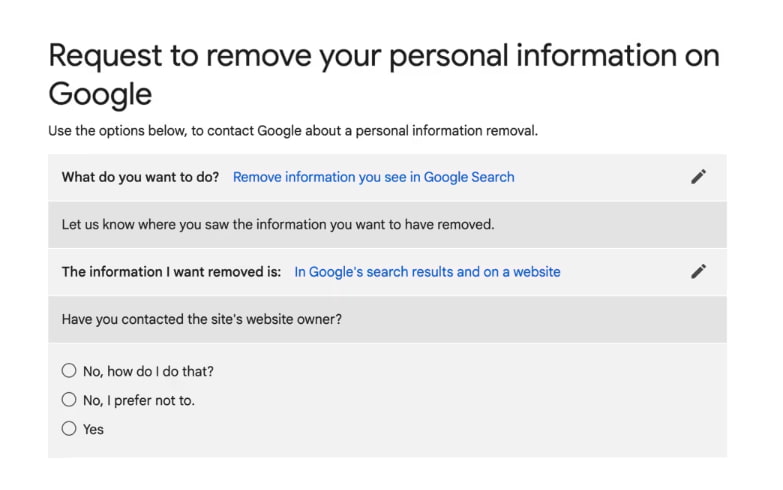
- Personal information removal tool. You can use it when your sensitive or private information is visible in search results.
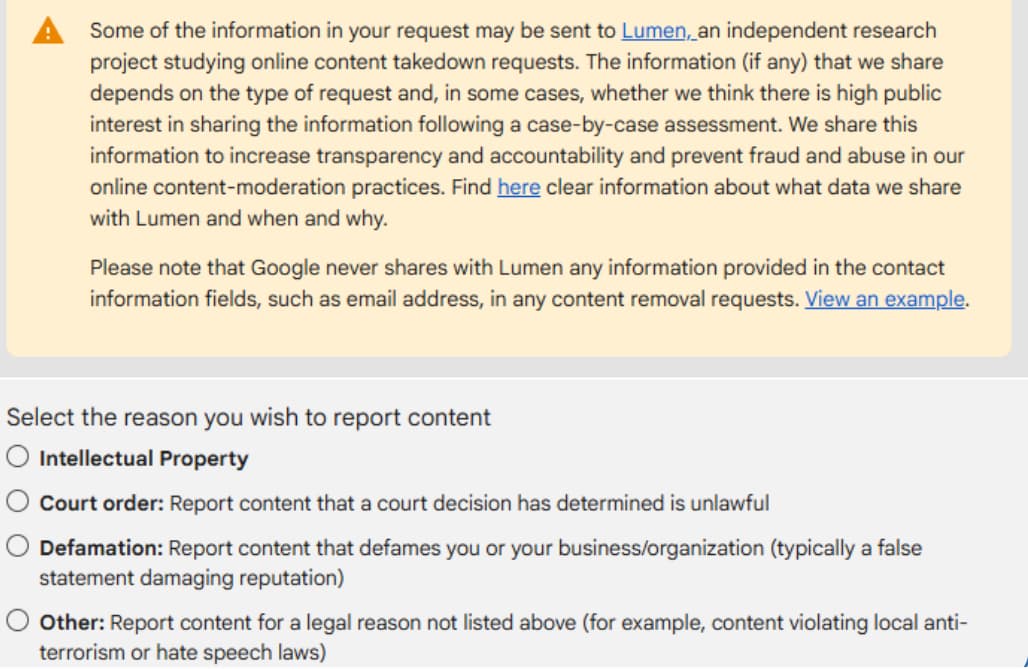
- Legal removal requests. This option can be sued for defamatory or false statements, unlawful content, or impersonation.
Each and every Google deindex request is reviewed manually by the content moderation and legal team. That is why you should expect a confirmation email that is usually sent within several days to weeks.
Step 3: Report the Page to the Website Owner or Platform
Even though you are not the owner, it is possible to speed things up significantly by contacting the platform or the website administrator. For this purpose, you should utilize the About or Contact section of the site. Your task is to send a polite message explaining what the web page includes, why it violates copyright or privacy, and the solution you expect.
If it is a platform like Reddit, Quora, or a local forum, you can use their built-in Report or Legal forms. Once the page is deleted by the site, you can then use Google’s Outdated Content tool to remove page from Google index.
Step 4: Escalate with a Legal or DMCA Notice
If the website refuses to cooperate or the content is clearly illegal, you can file a legal takedown notice:
- DMCA for copyrighted material, such as articles, photos, videos, and code.
- Defamation or Privacy Complaint for false statements or private information leaks.
- GDPR for EU citizens whose personal data appears online without consent.
Google takes verified legal requests seriously. If the claim meets requirements, they will remove the URL from search results. You can check removed URLs via the Google Transparency Report.
Step 5: Request Deindexing on Other Search Engines
Google is the biggest search platform, but there are other options. As soon as you deindex page from Google, you should do the same for other platforms where urls indexed may appear:
- Bing (Microsoft Content Removal);
- Yahoo. This one uses Bing’s search index, so your Bing request covers Yahoo results as well;
- DuckDuckGo. It relies on Bing and other data sources, which means that Bing removals usually reflect here, too;
- Yandex. This one offers its own removal and complaint forms for privacy and law violations.
What Should I Do If These Requests Are Not Successful?
The sad part is that even with clear evidence and the right forms, removal requests sometimes fail. Here are a few reasons why this might happen:
- The content does not violate Google’s strict policy definitions.
- The forms were incomplete or miscategorized.
- The website is hosted in a different jurisdiction with different laws.
- Multiple copies of the same content exist across different domains.
This is where many people give up, but you do not have to do that. When you cannot solve the issue yourself, professional removal services like NonDetected can often succeed by combining legal precision, technical SEO, and direct negotiation with hosting providers and platforms.
How Professionals Manage Deindexing
Our team of professionals specializes in such things, so we can easily deindex site from Google. Even though we tailor solutions to a specific situation, here is how our process often works:
- Assessment and strategy. We review the URLs, screenshots, and search visibility to determine the fastest and most realistic approach, which can be legal, SEO-based, or a hybrid.
- Legal coordination. Our specialists prepare DMCA, defamation, or privacy-based notices that meet Google’s compliance requirements. Many self-filed forms are rejected because of incomplete language or missing legal references.
- Technical and SEO deindexing. Our team utilizes specialized methods to accelerate Google’s re-crawling and reindexing. This way, harmful URLs drop from results or lose ranking visibility.
- Search engine and platform communication. NonDetected coordinates directly with moderators, site owners, and search engines to deindex a page from Google.
- Long-term monitoring. Our experts track your name or brand to ensure that once harmful results are gone, they will not appear again. The new ones are handled quickly.
Thanks to this combination of technical execution and legal precision, you can be sure that the unwanted content is gone forever and will never appear across multiple search platforms.
How Deindexing Affects AI Search and LLMs?
Here is a 2026 reality few people realize – which is that removing a page from Google or Bing results also reduces its visibility to AI models like ChatGPT, Gemini, or Copilot. The thing is that most large language models are trained or updated using public web data and search indexes.
When content is removed or deindexed from major search engines, it becomes less likely to be retrieved, quoted, or summarized in AI-generated results.
This means that if you erase harmful content from Google, you are also deleting it from the AI ecosystem. That is a strong reason to act quickly because what disappears from search results today cannot spread into AI summaries tomorrow.
When You Should Seek Professional Assistance
If you have already tried Google’s removal tools, filled out forms, and waited weeks without progress, it is high time to escalate. Professional assistance is the right solution when:
- The page appears on multiple domains or high-authority sites.
- The information is defamatory but not covered by Google’s strict definitions.
- The case involves impersonation or large-scale leaks.
- The language or legal terminology in forms is complex.
- You need guaranteed speed and confidentiality.
At Nondetected, we have successfully removed and deindexed thousands of harmful pages, from Reddit threads and blog posts to leaked documents and business reviews. Each case is managed discreetly and strategically to achieve impressive results because we know how to unindex a page on Google quickly.
Act Quickly and Solve the De Index Issue Today
Deindexing someone else’s page from Google is not easy, but it is absolutely possible. With the right evidence, carefully filled forms, and persistence, you can protect your privacy and reputation even without owning the content.
When these methods fail or take too long, professionals can step in to ensure success. The NonDetected team blends legal accuracy, SEO expertise, and years of real-world case handling to get the results that Google’s automated system often fails to deliver.
That is why there is no need to wait for the damage to spread. You should act as quickly as possible. You are welcome to use the provided information to deindex article from Google search, but professional assistance may be the right solution.
At NonDetected, we have outstanding specialists who will solve the issue quickly, and all you need to do is contact us.


