Google Refuses to Remove a Review. How to Appeal the Decision?

Getting a negative review is always stressful. Things become even worse if you report it to Google and receive a rejection. This is when you start wondering how to contest a Google review. Even though it might seem that nothing can be done if the engine declines a removal request, a refusal is not the end of the process. It just means that the second attempt requires a more strategic response.
NonDetected is an agency that has enough experience in solving such issues to share some tips with you.
Further, you can find information provided by our professionals, and it should be helpful if you face this kind of problem.
What Does a Review Removal Refusal Actually Mean?
Before you start figuring out how to appeal Google reviews, you should understand what this refusal implies. When Google declines a removal request, it usually means one of several procedural issues and not the final decision about the situation.
The review may not clearly violate platform policy, the submitted evidence might be incomplete or unclear, or the report could have been categorized under the wrong violation type. In many cases, the moderation decision reflects how the request was presented but not the underlying facts themselves.
That is why you still have chances to solve the issue. The thing is that there are numerous examples where businesses succeeded with their appeals after they strengthened their documentation. It is also critical to clarify policy references and utilize a more appropriate escalation channel.
How to Submit an Appeal in Google Business Profile?
The main thing that you should do is to move from frustration to structured action. Instead of submitting the same Google review appeal, you should focus on how to make it stronger. The professionals from NonDetected have shared a few practical steps, and you can find them below.
The guidelines will help you reduce reputational risk, regain control of the situation, and protect customer trust.
By approaching the process methodically and professionally, you turn a setback into an opportunity to strengthen how your business is perceived online.
Step 1: Re-Evaluate the Review Against Policy Language
Before you start the process again, you should pause and reassess the review carefully. It is necessary to get acquainted with Google`s prohibited content rules and compare them with the content of the review. All this can be done in your Google Business Profile.
Check The Status and Find the Right Policy Violation Option
Since only flagged reviews that violates Google policy can be removed, your task is to find certain violations because appeals succeed when they point to exact policy clauses, such as:
- Obvious conflicts of interest.
- Verifiably false factual claims.
- Harassment, threats, or hate speech.
- Content unrelated to a real customer experience.
Escalation will most probably fail if the review is simply negative. In this case, your strategy should be reputation repair and not removal.
Step 2: Strengthen Your Evidence Before Appealing Google Review
The bigger part of reports fail because people do not know how to appeal a Google review properly. In many cases, they just do not include enough documentation.
Prepare Documents to Dispute Google Reviews
Before you submit again, you should collect structured proof, including:
- Transaction records that show no customer relationship.
- Communication logs that contradict the reviewer’s claims.
- Screenshots of identical reviews posted elsewhere.
- Timeline inconsistencies that prove inaccuracy.
It is critical to organize this evidence logically. The thing is that moderators tend to review thousands of cases, so clarity matters more than volume. Moreover, you can submit only one time appeal if the initially flagged review didn’t qualify for a removal.
A concise, factual explanation supported by documents is far more persuasive than a long emotional complaint. Hence, your task is to act like an investigator, not a victim. Be Sherlock Holmes.
Step 3: Submit a Formal Appeal Through Support Channels
As soon as you finish improving your documentation, you should escalate through official support instead of re-flagging the same review under your business profile.
A strong Google appeal review should reference the previous case ID, introduce clear evidence, and specify the exact violated policy. You should do your best to avoid emotional language, threats, or accusations. The moderation team is more likely to respond to structured reasoning.
For this purpose, you need to sign in to your Google Business Profile Manager with the help of the email associated with your business listing. Then, you should locate the review you previously reported. If Google has already reviewed it and decided that there is no policy violation, you can start the appeal process through the Reviews Management Tool.
You need to follow these steps carefully:
- Open Reviews Management Tool
- Confirm connected account
- Select business profile
- Check review status
- Appeal eligible review
- Explain policy violation
- Upload supporting evidence
- Submit appeal request
Now, I’ll explain each step in detail so you can follow along and complete the Google review appeal yourself. Screenshots have also been added for your convenience.
1️⃣ Open the Reviews Management Tool in Google Business Profile.
2️⃣ Confirm the account connected to your business listing.
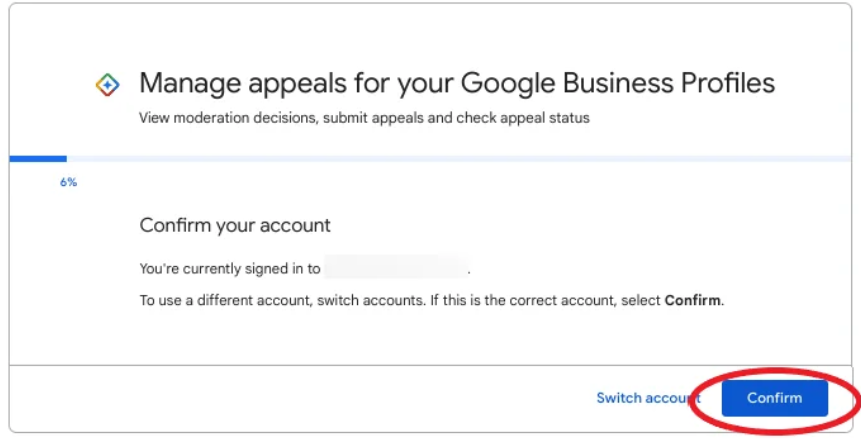
3️⃣ Select your business profile from the available list.
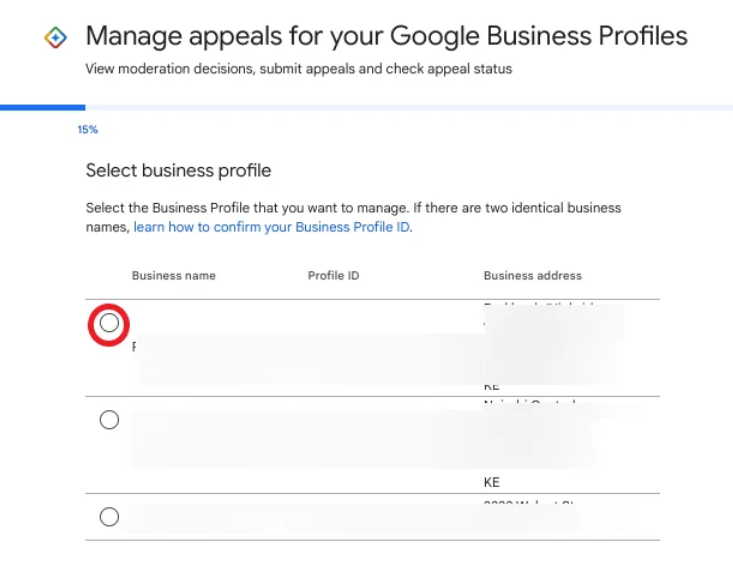
4️⃣ Choose the option Check the status of a review I reported previously and appeal options.
5️⃣ Select the review that you want to escalate and click Appeal eligible reviews.
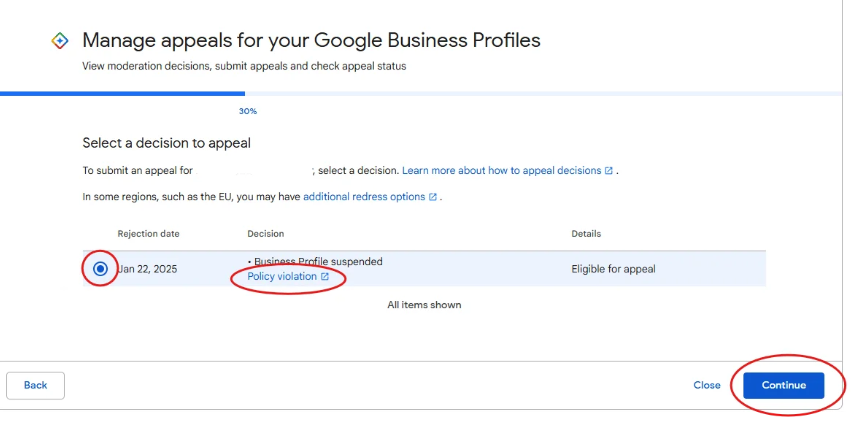
6️⃣ Complete the appeal form by clearly explaining why the review violates Google’s content policy.
7️⃣ Upload supporting documentation if the system allows attachments.
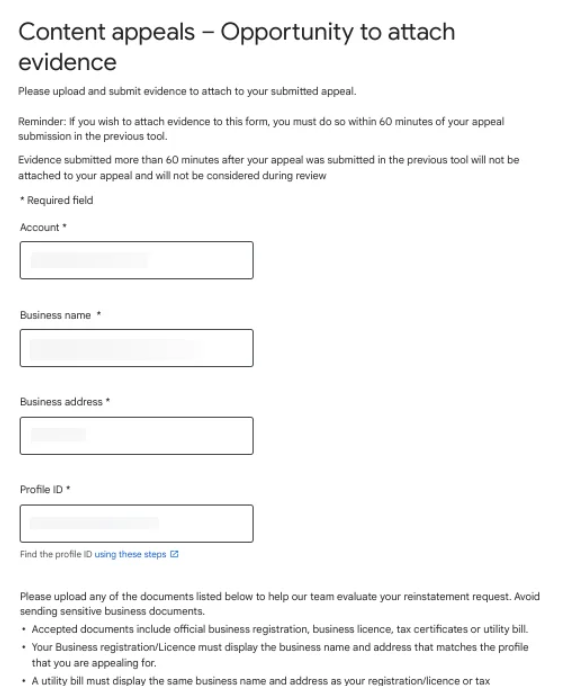
8️⃣ Submit the appeal and monitor your email for updates from Google support.
After you submit the appeal, the case will be reviewed by Google’s moderation team. In straightforward cases, responses may arrive within about 5 to 10 business days. At the same time, complicated cases or high volumes of requests can extend the review period.
Even if the appeal does not immediately result in deletion, this step creates an official record of your escalation. That documentation can be important if you later contact Google Business Profile support, escalate the issue through the community forum, or pursue further reputation management actions.
Step 4: Request a Secondary Human Review from Google Support
Unfortunately, not all requests are carefully reviewed. In most cases, Google uses automated spam detection to remove some inappropriate reviews, so the decision can be automated.
The great news is that you have the right to ask for manual reconsideration after your first request was rejected. This implies that you can expect a secondary human review and an explanation of what extra proof is necessary.
You may also ask them to clarify which policy criteria you failed to meet. Using this approach, you can understand what mistakes you have made and correct them to finally succeed.
Step 5: Shift Strategy From Deletion to Public Positioning
If your appeals fail many times, it is a better idea to focus on a different solution. At this stage, the smartest move is to control how the review is perceived. If you still haven’t responded to the unfair review, your task is to create a high-quality public response that calmly addresses the review and explains any misunderstandings. This surely demonstrates your professionalism.
You should also demonstrate professionalism to future readers and offer an offline resolution. You should consider that most clients will read your response more carefully than the negative review.
That is why the right reply can neutralize even a poor review.
Step 6: Reduce the Impact With New Positive Reviews
When removal is not possible, you should focus on visibility. Search and review platforms tend to prioritize recency, the volume of incoming feedback, and overall rating trends when they decide what users notice first.
Therefore, older negative or unfair reviews will be less visible if you manage to earn new positive feedback consistently. You should never manipulate, but you need to get a truthful reflection of genuine customer satisfaction.
Step 7: Record Harm for Potential Legal Review
People do not always go for legal escalation, and it is always a bad idea to do that out of frustration. At the same time, you might have no other option, especially if the negative review contains false claims and defamation. The solution is also what you need if it results in financial or reputational harm.
If you decide that you need legal escalation, you should ask for professional assistance from an agency, such as NonDetected. Filing a lawsuit might not even be required because a formal notice that showcases inaccuracies often results in reconsideration.
This approach must remain strategic, professional, and evidence-based, and NonDetected can help you succeed with that. We know how to challenge a Google review properly.
Step 8: Take Care of Your Reputation
A refused removal tends to reveal a deeper issue, which is reputation vulnerability. To avoid this problem, successful brands tend to build systems that include:
- Continuous review monitoring.
- Fast, empathetic customer responses.
- Consistent service quality improvement.
- Ongoing positive feedback generation.
If you use this approach, no negative review can significantly harm your business.
Is Professional Help to Submit an Appeal to Remove Reviews Really Necessary?
When it comes to Google appeal review, one of the most difficult realizations for brands is that complete control over public opinion does not exist. The thing is that digital platforms are created to keep the customer`s voice, even if it might seem unfair.
Therefore, real success comes from your ability to outperform criticism through reasonable responses instead of trying to erase every negative comment. This way, you can improve decision-making, reduce stress, and get better long-term outcomes.
The entire process can be time-consuming and complicated, so many brands decide to ask for professional assistance. Moreover, this solution is the best in most cases because experts know all the ins and outs of Google review appeal. It means that they will solve the issue quickly.
At NonDetected, we have a team of outstanding specialists who are there day and night to deal with your problems. You are welcome to contact us, and we will take care of everything.


